 My overview
 Help and answer


(DEMO) Better Health
With Grand Solutions, Innovation Fund Denmark (IFD) wants to invest in ambitious innovation projects with excellent science and strategic research that contributes to create new and tangible solutions to important societal challenges and creates value for Denmark.
The FORSK2025 catalogue is the basis and guide for the thematic calls.
Health is vital for the life quality of citizens. The public health area accounts for a large proportion of public expenditure and the life science industry is important for Danish export and prosperity.
Objective
Objective With this Grand Solutions call, IFD addresses cross-disciplinary issues, challenges and needs, nationally as well as internationally, where research and innovation is the value-creating element for Denmark, through the development of solutions to Danish societal challenges, which – in the short or longer term – will create growth and employment in Denmark.
The Grand Solutions call Better Health strives to invest in knowledge-based and cross-disciplinary solutions for Danish society, paving the way for unprecedented societal and market opportunities.
Areas of Investments
The call is aimed at innovation projects with specific or cross-disciplinary development of service, innovative products and/or processes within all fields. The ambition is for the results to drive forward the future financial and/or societal development or to find solutions to significant societal challenges, for example by ensuring that Danish public and private companies can maintain and/or develop their competiveness, nationally and/or globally.
Non-limiting examples of healthcare related challenges and needs, which lies within this Grand Solutions call, concern e.g. cancer, neurological and psychiatric diseases, chronic diseases, antimicrobial resistance, as well as physical, psychological and chemical health and safety, including how physical and psychological attrition in e.g. construction industry and farming can best be reduced. Please see the FORSK2025 catalogue for further details.
Furthermore, the development within healthcare yields a strong Danish and international demand and need for new knowledge, clinical research, including metastudies of effects and side effects, psychotropic drugs versus non-pharmacological interventions, technology and solutions for better and cheaper prevention, diagnostics, treatment and rehabilitation in the somatic and psychiatric fields. In addition, personal medicine is a particularly promising area, where the potential gain for patients, healthcare and industry is significant e.g. within the cancer area, and where international research collaborations are important.
DKK 25 mill. of the DKK 120 mill. are allocated to application-oriented and practice-oriented research in a citizen-based and technology-supported healthcare system. The research should help develop and implement technological solutions to support a well-functioning healthcare system and make the individual citizen more self-reliant, thus enhancing the individual’s personal freedom. The research may enable people to become more directly involved in prevention, treatment and rehabilitation through e.g. new technological developments. Furthermore, research may support the effective organisation of a cohesive healthcare service, where citizens and health professionals experience good patient care. This, amongst other things, may strengthen the research base for health training and competence development in the healthcare system.
Innovation projects within the present call, Better Health, may support the UN Sustainable Development Goal no. 3: Good health and well-being.
Theme Specific Strategy
IFD will contribute to the Danish life science ecosystem – consisting of research communities, companies and public institutions – enabling it to compete with the very best life science regions in the world.
IFD believes, that it is important to create value for patients and for Danish society through investments in projects dealing with disease treatment and/or chronically ill patients, as well as the organisation of healthcare in the most appropriate way for patients and society, e.g. seen in relation to rapid diagnosis and treatment in order to maintain the patient’s connection to the labour market. IFD thus welcomes projects regarding e.g. patient care and/or the dissemination of “best practice” methods within the general health area or within specific subject areas. In addition, IFD invests in projects aimed at improving biological disease understanding, new diagnostics and new treatment.
IFD invests in strategic science and research and innovative solutions within Better Health, which have a clearly defined aim and expected effect(s). Please also refer to IFD’s specific investment strategy for health and the listed guidelines for the allocation in FORSK2025.
Assessment Criteria
With the Better Health call, IFD invests in strategic research projects and innovative solutions, which have a clearly defined aim and expected impact. It is important that the aims are clearly defined, and the path to the goal is substantiated, for example that the project group comprises the necessary competences. The solutions must have considerable societal or market potential – short or long term. It is not a prerequisite that the project leads to a commercial product but it is a requirement that knowledge created in the project creates value by bringing the project forward in well-defined and value-creating steps towards new solutions.
IFD will always prioritise investing in excellent knowledge-based innovation projects providing solutions of the highest quality, regardless of subject and specific field.
The main assessment criteria are:
- Quality of science, research and innovation
- Value creation during and after the project period
- Efficiency of project execution
- Implementation of results
For applications for Grand Solutions 2019 Better Health, value creation is broadly defined as targeted activities leading to increased growth and employment through for example developing new products and services, creating more and value-creating jobs, increasing productivity, lowering social costs, reducing resource consumption or reducing climate and/or environmental impact and solving significant societal issues.
In the application, the partners must describe the tangible value creation in the project. Value creation is not restricted to monetary value but may also be, for example, health economy parametres, e.g. increased life expectancy, reduced burden of disease and treatment need, improved quality of life and reduced environmental impact etc.
IFD prioritises applications where the project creates measureable value for Denmark and the Danish society. The project must possess considerable potential and result in new solutions or products, for example through development and utilisation of new untraditional, potential disruptive business models, methods, smart regulations etc.
IFD invests in innovation projects having a clear recipient or beneficiary in mind and potential to become attractive for other investors. The issues and needs must be clear and the solutions should not be previously available (globally). Further, the value creation should be measureable (e.g. health economics parameters, societal or monetary value).
IFD is willing to invest in high-risk projects if the partners also commit resources and knowledge to the project and if the risk is well described. Thus, the project governance model and quality of the project plan are crucial. Therefore, it is important that the recipients/beneficiaries and core stakeholders either participate to form the project, participate in the project or are otherwise involved in the project, e.g. through investment, and this will be taken into consideration when assessing the innovation project.
The application will be assessed specifically on the qualities of the project in relation to excellent science, research and innovation in a global perspective with respect to an articulated or latent unmet need, state-of-the-art, directly competitive or similar scientific or technological solutions, solution scalability, technical, regulatory and market risks, risk management in the project plan and project implementation. In addition, development rate, efficient use of invested resources, leadership and scientific skills and the subsequent efficient implementation of the project results nationally and/or globally will be carefully assessed. The project’s value creation will be assessed in relation to the size and risk of the investment.
Reference is made to Guidelines for Grand Solutions 2019.
The allocation of funds is based on the National Budget 2019 and FORSK2025 catalogue as listed in the National Budget, as well as the 2019 Allocation of the Research Reserve.
Advice and guidance
-
Documents
- Guidelines for Grand Solutions-published April 2020_0.pdf
- GS 2019 Budget – visningseksemplar.pdf
- grand-solutions-2020-ansogningsblanket.pdf
- Appendix A_phase 2_figures pictures tables_0.docx
- Appendix B_phase 2_participant motivation.docx
- Appendix C_phase 2_key persons.docx
- IFD_expert_assessment_guidelines_2020.pdf
-
Here are the standard documents needed for the investment agreement as well as guidelines and background material for the agreement negotiations.
The project participants are free to choose if they wish to prepare the agreement material in Danish or English.
Documents
- GS20_Bilag 1 – Projektplan.docx
- GS20_Bilag 2 – Organisation og ledelse.docx
- GS20_Bilag 3 – Budget_note.docx
- GS22_Exhibit 4 – Rules of procedure for the Steering Committee.docx
- GS20_Exhibit 5 – Collaboration Agreement – With UK logo_0.docx
- gs20_investment-agreement.pdf
- samlede-erkaeringer-ikke-kriseramt_de-minimis_smv-eng.docx
- GS22_Guidelines – agreement negotiations.pdf
- GS22_Guidelines – Collaboration Agreement.pdf
- Guidelines for Grand Solutions-published April 2020_0.pdf
- inspirational-draft-collaboration-agreement.pdf
- gs19_responsible-research-and-innovation-_-innovation-fund-denmark.pdf
- gs19_krav-om-ansvarlig-forskning-_-innovationsfonden.pdf
- gs19_open-access-policy-for-public-research-councils-and-foundations.pdf
- bilag-2b-datasheet.xlsx
Questions and answers
-
Innovation Fund Denmark defines innovation as the process that, through the realization of new ideas in practice, creates value from knowledge. It is essential that the ideas have an actual application, and projects that only create new knowledge are therefore not immediately innovation projects.
Innovation Fund Denmark can invest in projects located throughout the value chain. The division between basic research, strategic research and applied research can be difficult in practice, but Innovation Fund Denmark invests in research and development that creates value and which must be implemented in society in the short or long term. It is important that the results are implemented either by the partners or a defined buyer, and Innovation Fund Denmark therefore emphasizes that there is a clear implementation strategy in the project, and that the buyer plays a significant role in the project.
Examples of concrete value creation are given in the specific thematic and in the open call.
-
It varies a lot from year to year and between the individual calls. The success rate based on the number of applications is approximately 10-20%.
It depends on the number of applicants and the framework for the call in question. Projects that are invited for interviews are generally of high quality. We expect those who are invited to the interview to have a success rate of approximately 40-50%. That is, if you are invited, there are expected to be great chances of obtaining an investment from Innovation Fund Denmark.
-
All types of innovation projects are welcome, but one must be aware that the requirement for quality, concrete value creation, efficiency and probability of implementation is crucial. Open call covers academically broader than the thematic calls. All project applications compete against each other and there are no professional preferences. Innovation Fund Denmark’s Board of Directors selects the projects that together provide an optimally balanced investment portfolio in terms of investment size, value creation, risks and location in the innovation value chain.
As a starting point, projects applied for within a specific academic theme compete only against each other and according to the subject-specific theme call. Each theme must therefore be seen as a pool determined politically. However, Innovation Fund Denmark will always ensure that the requirement for quality, concrete value creation, efficiency and probability of implementation still applies across the individual themes.
In the open call, all project applications compete with each other regardless of subject within the overall framework.
-
The investment framework and themes are in most cases politically decided and are typically finalized in the context of the Finance Act. Therefore, the call text and the final framework can only be published when a political settlement is submitted. Innovation Fund Denmark will strive to be able to publish preliminary call texts or themes as early as possible. In addition, the board can allocate funds to specific focus areas.
The themes and especially the investment framework can vary from year to year – but the biggest themes often recur. One can therefore make a qualified guess as to what general themes are coming up by looking at last year’s themes. Often, new themes or sub-themes will be derived from the traditional subject themes. The final calls will be announced as soon as the grant basis has been adopted. The open call is not subject-specific and embraces all areas, but has the common requirement for quality, concrete value creation, efficiency and probability of implementation.
-
We place great emphasis on projects not stopping when our investment ends. We want the projects to lead to value creation for Denmark. This is most easily ensured by the fact that the project purchaser is an integral part of the project. For more information, see the answer to the question “What is innovation?”.
-
First and foremost, the governance structure of the project and the organization must be balanced and reflect the challenges, complexity, budget and size of the project. It is recommended that the steering group, which is the project board and has the strategic management, have representatives from the most important partners and those who benefit from value creation. In addition, the members must have sufficient decision-making power to be able to resolve, for example, resource conflicts in the project. It is important that the members of the steering group are not part of the daily operation.
The project manager is the project director and takes care of the daily tactical management, both up and down, and communication with all stakeholders. Innovation Fund Denmark places great emphasis on the project manager’s qualifications for effective management of people and management of stakeholders.
It is recommended that the project administrator comes from the most financially stable partner, such as a university or GTS institute, and not from eg and SMEs.
-
Is it correct that you can get a quick negative response to your application?
This is correct. Innovation Fund Denmark will strive to be able to provide a quick response if the board has rejected an application – also within 100 days from the application deadline. This is in line with many applicants’ wishes for fast case processing, so that the applicant and the project team do not waste time and can move forward with a better application and / or project.We have previously had an application rejected; can we apply again, or will we be quarantined by the Grand Solutions program?
If the project is improved, it is always possible to apply again. Innovation Fund Denmark has no quarantine period for rejected applications or applicants.No, feel free to submit a new and improved application on the same or another project next time there is a Grand Solutions call. It is Innovation Fund Denmark’s experience that several of our best projects have experienced a previous rejection and then been improved and sharpened – also often after a good dialogue with Innovation Fund Denmark employees.
Is it an advantage if it is a university or a company that is applying?
It does not matter who the applicant is. It is the entire project, including the partners’ qualifications, motivation and contribution, that is assessed by the board. However, it is important that the buyer plays a significant role in the project.Should the project applicant and project manager be the same person?
There does not have to be a coincidence. It is important that the project manager has the experience and qualifications and time for the specific project.How do I insert references in the application?
It is possible to insert references in Appendix A.How to specify external co-financing?
External funding is described in the comments field (Overview) in the budget form.Is it possible / necessary to send letters of recommendation to the application?
In general, “endorsement letters” or letters of recommendation will not be included in the evaluation process, and it is therefore not necessary to enclose one. Evaluation of the application is based on the content of the application, which is assessed on the basis of the criteria described in the guidelines.“I submitted the application form on e-grant but did not receive a PDF file with the entire application – now I’m not sure if you registered my submission”
After checking your application, you can choose to have the draft sent to you as a PDF file. When you finally approve and submit (Submit) application, it will be registered with a timestamp stamp immediatelyAfter the application form is approved and submitted on e-grant, a single PDF file is created. This may take several minutes. Very close to the application deadline, where there is a lot of activity, it can take up to an hour.
Subsequently, the submitted application can be read on e-grant. It will also be possible to have it sent by email. The application can be reopened until the deadline, but remember to submit the latest version.
Guide to e-grant: https://ufm.dk/forskning-og-innovation/tilskud-til-forskning-og-innovati…
e-grant technical issues
Phone hours: 9 – 12, tel .: 3392 9190
Email: support.e-grant@fi.dk -
Applications are assessed on the basis of the criteria as described in the guidelines. The Board of Directors decides which applications are sent for peer review and invited for an interview with Innovation Fund Denmark. The received peer reviews are sent for consultation to the applicant via the project’s contact person.
On the basis of an overall assessment consisting of internal assessments, assessments from peers, any party consultation responses and project interviews with the applicant, the Board of Directors decides which applications will be invited to investment negotiations.
Employees, management, the board and research experts may be involved in the assessment of the application.
In addition, applications are sent for peer review. The Foundation sends all peer reviews for consultation with the applicant, where it is possible to comment on peer review.
-
No, it’s a supplement to the application, not a TV show. Selected applicants will be asked for a brief introduction of the project of 15 minutes, and then it will be a confidential conversation about the project with Innovation Fund Denmark’s employees, management, external consultants and possibly board members. The purpose of the interview is to clarify any ambiguities in eg goals, value creation and plan or discover additional potentials. The interview format is chosen to save the applicant’s time and most effectively provide a comprehensive decision basis for the specific application.
-
It is important that projects relate as well as possible to the specific call. At the same time, the Fund has its three overall decision criteria: quality, value creation, efficiency and implementation, which work independently of the specific calls. Ultimately, the assessment is based on the most important quality and potential for value creation.
-
For industrial research, the focus is on the acquisition of new knowledge, etc., and for “experimental development” the focus is on the utilization of existing knowledge.
The EU definition of industrial research and experimental development is described in the EU General Block Exemption Regulation: http://eur-lex.europa.eu/legal-content/EN/TXT/PDF/?uri=CELEX:32014R0651&… (definitions in paragraphs 85 and 86, Article 2, page 25).
-
As a starting point, all partners (business organizations, interest groups as well as organizations and companies) that carry out financial activities, ie. provider of goods or services in a market, apply the budget rules for companies in Denmark and abroad under section 3.4.1 of the guidelines, including the maximum investment ratios.
If a partner carries out non-financial activities, Innovation Fund Denmark has, after a specific assessment the opportunity to increase the maximum investment rate. Inquiries must be made in good time before the application deadline.
-
Innovation Fund Denmark’s investment is conditional on the project parties entering into an investment agreement with the Fund on the project’s organization within 60 days of the written invitation to the investment negotiation. The project must then be started no later than 60 days after the investment agreement between the partners and Innovation Fund Denmark has been signed by all parties.
-
Yes. The most important thing is that the results of the project benefit Denmark. International knowledge plays a very large and important role here, and it is essential that the project’s ability to create growth and employment in Denmark is argued.
-
SSH is an abbreviation of ” Social Science and the Humanities ” (in Danish often called HUM / SAMF) and includes a large number of research disciplines or disciplines such as economics, politics, law, psychology, history, linguistics, media studies, pedagogy, philosophy, sociology, ethnography and many more.
Innovation Fund Denmark requires that there is a plan for the implementation of the solutions, and here SSH can sometimes help.
Innovation Fund Denmark places great emphasis on Grand Solutions’ projects focusing on solutions that are in real need of – and that can be implemented.
This often means that projects can integrate humanities and social science research and innovation from the beginning. These disciplines can often contribute valuable knowledge related to eg behavior, incentives, regulation and market conditions.
This kind of knowledge can, for example, help to clarify how a given technology, idea or solution will affect the individual, organization or society in general and provide input on how any barriers to implementation can be overcome.
Contact
-
Technical questions regarding e-grant
Phone hours: 9:00 – 12:00, phone: 3392 9190
Mail: support.e-grant@fi.dk
Technical support regarding e-grantGeneral questions regarding Grand Solutions
Peter Aadal Nielsen
Phone: 6190 5064, mail: peter.aadal.nielsen@innofond.dkThomas Mathiasen
Phone: 6190 5063, mail: Thomas.Mathiasen@innofond.dkMain phone number to Innovation Fund Denmark
Phone: 6190 5000, Phone hours: 9:00 – 15:00
The program
-
Any legal entity in Denmark or abroad can be a project participant and receive funding from Innovation Fund Denmark eg.:
- Businesses
- Research institutions
- Public institutions
-
You can apply for funding for projects that create societal value and/or economic value in Danish public and private companies and/or from buyers in society, for example from citizens, the state, regions and municipalities.
A buyer can be an end user of the innovation, but it can also be a public or private investor who is willing to invest in the project after the Fund’s commitment is completed.
It can be an advantage if the purchaser(s) of the project’s results and other core stakeholders are involved as active participant(s) in the design of and through the project.
-
Grand Solutions projects will range from DKK 5,000,000 – 40,000,000
-
The money can co-finance expenses for salaries, equipment, other project-related costs, external services, etcetera.
The budget must include all direct project costs, meaning costs that can be directly attributed to the project, regardless of whether the costs are to be covered by Innovation Fund Denmark or will be covered by the project participants themselves or another party.
For further details, please see the programme guidelines.
-
The projects are of 1 to 5 years duration.
Application
-
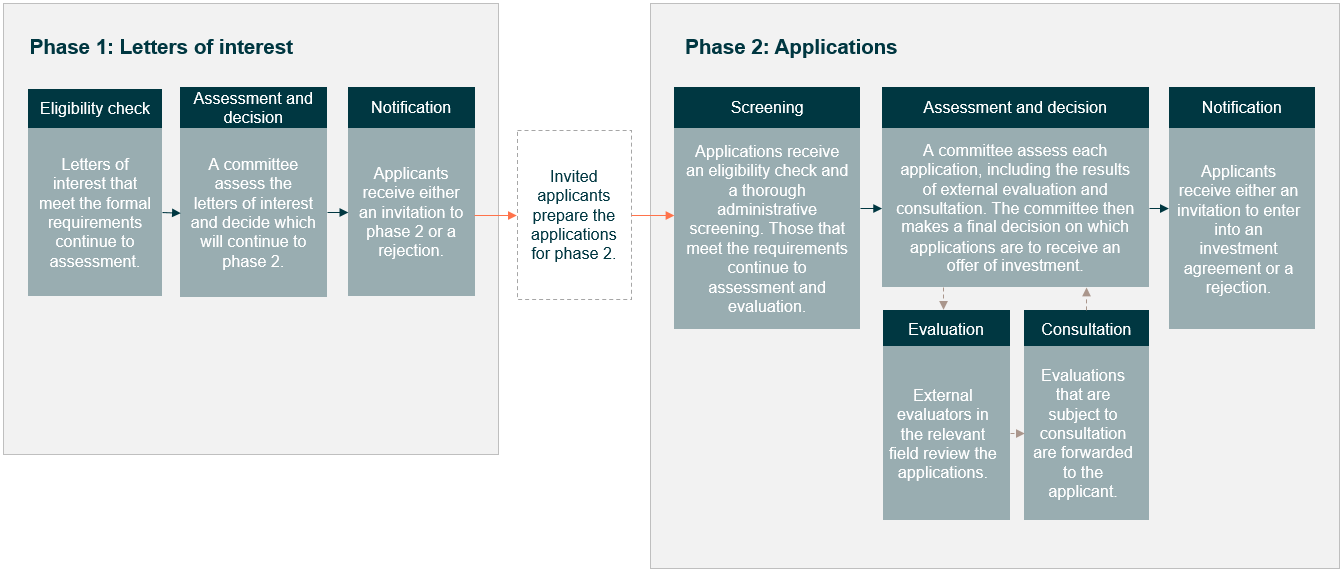
The application process for the Grand Solutions programme consists of two phases.
In phase 1, all interested applicants submit a short letter of interest, outlining their project. On this basis, applicants will either receive an invitation for phase 2 or a rejection.
In phase 2, the invited applicants submit a final application, describing their project in detail. When Innovation Fund Denmark has assessed all applications, the fund makes a decision as to which projects will be invited to enter negotiations for an investment agreement.
The application material for both phases must be created and submitted via the electronic application system: www.e-grant.dk. You must register as a user of the system with either a username and password or with MitID before you can create an application.
You create a new application by finding the correct call under “Search Options” and pressing “Start your application”. Note that the list of search options is sorted alphabetically and that the names of all calls from Innovation Fund Denmark start with “IF”.
You must write your application material for both phases in English.
You can find a guide to e-grant on the website of the Danish Ministry of Education and Research.
-
In both phases, the application consists of an electronic application form designed in the electronic application system e-grant (www.e-grant.dk), which you must fill out in English.
Your application must have an official title (maximum 180 characters including spaces), which briefly describes the project for which you seek investment. You must also enter an acronym.
Application for phase 1
In phase 1, the application is a letter of interest and must contain:
- Official project title and acronym
- Short summary of the project (maximum 600 characters)
- Overview of the expected budget and duration of the project
- Requested total investment from Innovation Fund Denmark
- Foundation and concept of idea (maximum 1,800 characters)
- Quantifiable goals (maximum 1,200 characters)
- State of the art and competition (maximum 2,400 characters)
- Expected impact (maximum 1,200 characters)
- Description of the project’s methods used (maximum 1800 characters)
- Contribution for up to 5 core project participants (maximum 600 characters per participant)
- Description of any other project participants and their contributions to the project (maximum 500 characters per participant).
- Description of competencies and experience for up to five key people (maximum 600 characters per person)
- Literature list (maximum 1200 characters)
- Budget overview (see the instructions in the application form in e-grant for further information)
The following optional appendices can be attached to the electronic form: Appendix A: Figure (max. 1 A4 page with max. 1 figure)
Application for phase 2
In phase 2, the application is a full application. The content of the electronic application form for phase 2 and the corresponding appendices will be announced in the invitation to applicants who make it to the next round. You can find more information on which adjustments are allowed from phase 1 to phase 2 in the programme guidelines
You can also see a preliminary outline of the application form for phase 2 below – please note that this is only a preview of the expected application form and that the final form may be subject to change.
Documents
- Appendix B_phase 2_participant motivation.docx
- Appendix C_phase 2_key persons.docx
- societal_readiness_levels_-_srl.pdf
- technology_readiness_levels_-_trl.pdf
- Preliminary outline of application form for phase 2 of Grand Solutions 2024 – Innovation Fund Denmark.pdf
- Appendix A_phase 1_Illustration (5).docx
-
The programme text for Grand Solutions has been updated in February 2024. To learn more about the changes to Grand Solutions, visit our Q&A here.
Evaluation
-
-
{“preview_thumbnail”:”/sites/default/files/styles/video_embed_wysiwyg_preview/public/video_thumbnails/avYQGIS8CSw.jpg?itok=9v9qPxcC”,”video_url”:”https://www.youtube.com/watch?v=avYQGIS8CSw”,”settings”:{“responsive”:1,”width”:”854″,”height”:”480″,”autoplay”:0},”settings_summary”:[“Embedded Video (Responsive).”]}
The applications are assessed by four committees with members who convene and qualify evaluations on committee meetings. The committees have the competence to assess as well as make decisions and are thus the bodies in which applications are evaluated and decisions on investments are made.
The committees consist of 10-18 members, divided between established international researchers and impact specialist with extensive knowledge of Danish affairs.
In phase 2, the applications are also assessed by external evaluators, and evaluations that are subject to consultation are sent to the applicants as part of a consultation process.
Applicants who are not invited for phase 2 or to enter an investment agreement after phase 2 will receive a rejection stating why.
Special conditions in 2024:
In 2024, letters of interest for phase 1 of the application process will be assessed internally and by external evaluators (including a consultation process for applicants) and decided by Innovation Fund Denmark’s board of directors. The reason is that the new committees are introduced for the first time in 2024 and will not be functional until later this year. Applications for phase 2 will be evaluated by the new committees in the second half of 2024.
-
Applications for the Grand Solutions programme are evaluated based on three overall decision criteria:
- Quality of idea
- Impact
- Quality of execution
You can find further information on the three overall criteria and their sub-criteria in the guidelines for phase 1 and phase 2 of Grand Solutions. Please note that the sub-criteria for the two phases are not identical.
-
In phase 1, applicants will receive either a rejection as response to their letter of interest or an invitation for phase 2, in which applicants must submit a full application. The decision will be notified to you via e-grant.
In phase 2, invited applicants will receive either a rejection or an offer of investment and thus an invitation to negotiate an investment agreement. The decision will be notified to you via e-grant.
-
Applicants for Phase 1 of Grand Solutions will receive a response after 10 weeks.
Applicants who progress to Phase 2 can expect a 12-week response time in this phase itself and a total time horizon of 9 months from the time the expression of interest is submitted in Phase 1 until they receive a final response in Phase 2.
-
The programme text for Grand Solutions has been updated in February 2024. To learn more about the changes to Grand Solutions, visit our Q&A here.
From approval to project start
-
An investment from Innovation Fund Denmark is conditioned by the project parties entering into an investment agreement with the fund on the organisation of the project no later than 60 days after receiving the written invitation to investment negotiations.
The project must be started no later than 90 days after this investment agreement has been signed by all parties.
Innovation Fund Denmark may demand repayment of parts of the investment if the agreed conditions are not met. You can find more information in the investment agreement and the document containing the general terms and conditions for the programme.
-
Below, you will find the standard documents needed for the investment agreement negotiations.
You are free to choose whether you want to prepare the agreement in Danish or English.
Documents
- GS24_Exhibit 1 – Project plan.docx
- GS24_Exhibit 2 – Organisation and Management.docx
- GS24_Exhibit 3 – Budget note.docx
- GS24_Exhibit 4 – Rules of procedure for the Steering Committee.docx
- GS24_Investment Agreement.pdf
- GS24_Collective declarations.docx
- GS24_Guidelines – agreement negotiations.docx
- GS22_Policies for research grants.pdf
-
The project can start as soon as there is an approved investment agreement and it must start no later than 90 days after the agreement has been signed by all parties.
During the project
-
The payment is generally made two times a year and is handled in collaboration with Innovation Fund Denmark and the financial administrator appointed by the project.
-
Innovation Fund Denmark is an active partner in all Grand Solutions projects and engages proactively with the project for its entire duration. Specifically, Innovation Fund Denmark appoints one or more investment officers to carry out this task.
The project follow-up and the requirements for accounts and reporting will be evident from the investment agreement that Innovation Fund Denmark enters into with each project.
-
Innovation Fund Denmark may terminate the investment ahead of time if the Fund considers that there is insufficient progress, the project proves aimless, or if the project is unable to achieve the objectives which the Funds’ investment to the project is based upon.
There will be an ongoing dialogue between the appointed Investment Officer from the Innovation Fund as well as with the steering group of the project about the progression of the plan.
-
At the project’s last steering group meeting, the completed accounts are reviewed and the project’s progress and results are evaluated.
Guidelines and general terms and conditions
-
Since publication in February 2024, the following clarifications have been made to the guidelines:
- The overhead for hospitals and museums has been corrected to 3.1% and selected organisation types have been specified as Danish or non-Danish
- It has been specified that there are no limitations on budget changes performed between core project participants
- It has been specified that the main applicant is responsible for contact to IFD during the application process
- Clarifications have been made to the time frame for investments covered by the de minimis regulation
Documents
Process in case of missing consultation
-
Innovation Fund Denmark has become aware of an error in the processing of some of the applications for the Grand Solutions, Innofounder and International programmes in the years 2015-2021. Applicants who want to clarify whether the error is relevant to them, and possibly wishes to raise a claim for compensation, can contact Innovation Fund Denmark. Read more here (in Danish)
Process in case of lack of recognized researcher
-
Innovation Fund Denmark has become aware that a case processing error has occurred in connection with the appointment of reviewers in the evaluation of applications for the programs “Industrial Researcher”, “Grand Solutions” as well as the two international programs “EUREKA” and “bilateral collaborations”. Applicants who wish to clarify whether they are covered by the error, can read more here
Sammenligning af EUDP- og Grand Solution-programmer
Calls
-
Here you can find and download call texts
Documents